
- Introduction:
Money plays an integral role in the functioning of terror groups. These groups cannot operate and achieve their objectives without having access to money or the ability to move money around. While planning a single terrorist attack may not require large sums of money, large transnational terror groups require funding to achieve their broader strategic goals. Terrorist financing refers to both the activities undertaken to fund terrorist activities as well as its distribution. Sources of terror financing vary across groups. Terror groups can be reliant on donations or they can be more self-sufficient and enterprising. The activities that terrorist financing facilitate include recruitment, weapons, popular support, and other activities. For groups with ambitious agendas, steady funding ensures their survival and facilitates the mobilization of their aims.
Cooperation among terror groups and criminal groups is concerning for law enforcement but the adoption by terror groups of activity usually attributed to criminal groups presents a greater challenge. Poor governance, geopolitics, and extremist ideology have created safe havens for many terror groups. Beyond kinetic action, local governments and Western powers have sought to go after the finances of these organizations. International frameworks have facilitated action in going after terrorist financing and associated money laundering activities.
It is incumbent on the financial sector to play a role in countering terrorist financing. In the post-9/11 era, there has been greater mobilization by the financial sector to monitor and report suspicious activities among their transactions. Compliance departments are being given more resources than in the past. While terrorist financing may not be their sole focus, good compliance programs can give insight into international trends—especially those doing business in high risk regions. The challenge in countering terrorist financing is growing more complex as terror groups diversify their methods.
- Sources of Terrorist Financing and Convergence with Criminal Activities
To get a complete picture of terrorist financing, this section will examine both the sources of funding and the convergence of terror activity with criminal activity. Terror groups need money for recruitment and training, weapons, popular support, support for other groups, buying influence, and maintaining their network. The larger the organization and the more ambitious its agenda, the greater the need for diverse funding and money laundering activities. According to Koh, “given the constant need for a ready supply of cash, weaponry, ammunition, and other essential resources, modern terrorist groups turn to various financing activities which can fall into three categories: criminal activities, donations, and legitimate businesses (Koh 19).” The focus of this section is criminal activity as it is the most important source of terrorist financing. These activities can range from oil smuggling, extortion, kidnapping, antiquities trade, drug trafficking, and many others.
Specifically, drug trafficking has become an important source for many terror groups. Terror groups in the Middle East can rely on “specific fatwas (ideological decrees) from Islamist luminaries openly authorized Islamist terrorist groups to use drugs as another weapon to attack the West (Koh 20).” The most vivid example of a terror group engaging in drug trafficking to fund its operations is the March 2004 Madrid train bombings. Soon after the attacks, “the investigators found that the financial activities of these terrorists were intimately connected to those of a drug trafficking group, thus lending credence to arguments that there is growing cooperation – and perhaps a nexus – between organized crime and terrorism (Biersteker 126).” This convergence between terror groups and criminal groups is becoming a greater focus for law enforcement.
While the nexus of terror groups and criminal groups is a concern for law enforcement, it may be surprising to note the evidence for it is circumstantial and not overwhelmingly supported by empirical data. Overall, there are two trends of concern: the use of criminal methods by terrorist groups and the radicalization of criminal groups. Research indicates that “while terrorists and criminals are often co-located, usually in regions or countries where good governance is absent, proximity alone does not necessarily mean that they actively cooperate with each other (Biersteker 127).” This could be because the two groups have different objectives, profit motive versus ideological motive. It is clear, however, that both types of groups engage in the same types of criminal activities—even if they do not actively cooperate. The appropriation of criminal behavior by terrorist groups is becoming more common than cooperation. This is because “do-it-yourself organized crime is equally useful for terrorist organizations and has become an increasingly important source of funding for Islamist terrorist organizations as actions by the United States and the international community have made funding from charities and from sympathetic financiers more problematic (Bierseker 130).” As terror groups aim to become more self-sufficient through criminal activities, they do interact with criminal groups. However, the distinction between entities and activities is important because any entity can use organized crime as a vehicle to accomplish its goals. As terror groups become linked to criminal activity, the role of money laundering also increases.
As discussed earlier, terrorist financing refers to both the money-making activities and the distribution of those proceeds. Traditionally, the process of money laundering is as follows “firstly, cash enters into the domestic financial system either formally or informally; secondly, it is sent abroad to be integrated into the financial systems of regulatory havens; and, thirdly, it is repatriated in the form of transfers of legitimate appearance.” The goal, traditionally, is to turn dirty money into legitimate money. For terrorists, this is not the goal of money laundering activities. Rather, their goal is to move money in a clandestine manner that disguises the identities of both the sender and the recipient. The diagram below outlines the differences between money laundering and terrorist financing:
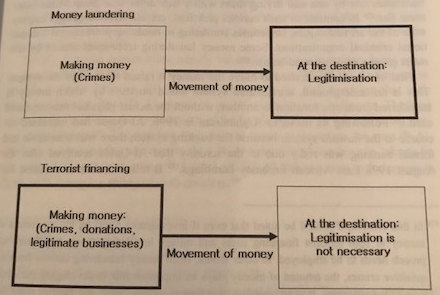
To refer to the diagram above, “despite the difference in their final goals, what money laundering and terrorist financing share in common is the concerns about how to erase the money trails as represented by the overlapping middle bold line (Koh 27).” This overlap makes it possible to use traditional anti-money laundering techniques to counter terrorist financing. Some money laundering techniques employed by terror groups include use of the hawala system, wire transfers, and basic methods such as cash smuggling. The hawala system is “an underground, unregulated system based on trust by which money is transferred from one location to another, without the actual physical movement of cash (Koh 28).” This system is not in itself illicit but it is common in the Middle East and South Asia and has been exploited by terror groups. Wire transfers have been used extensively by terror groups, for example, “Mohammed Atta, initially viewed as a principal of the 9/11 hijackers, is alleged to have used Western Union to send $15,000 from the United States to other al Qaeda members in the United Arab Emirates (Anderson 76).” The use of wire transfers makes it easier for law enforcement to track the money of terror groups. Finally, basic methods such as cash smuggling cannot be ignored. With cash couriers, terror groups can move large sums of money to fund their operations. This highlights the need of multifaceted approaches to counter terrorist financing.
- Banking Regulations Aimed at Countering Terrorist Financing:
The problem of terrorist financing raises questions about the responsibility of the financial sector in stemming the financial activities of terror groups. The 9/11 attacks mobilized both the United States and the international community to find ways for public and private entities to cooperate in mitigating the threat posed by terrorist financing. Anti-money laundering programs which are not necessarily new, can be effective in the fight against terrorist financing when those activities intersect with criminal activity. Banks in a good position to be on the front-line in the efforts to mitigate the threat because they are often multinational and terror groups are reliant on the international financial system. The idea of banks having a role in mitigating the threat is not new. In 1990, it was “the Financial Action Task Force on Money Laundering (FATF) that fully brought forward this idea of responsibilisation into the international context, the core of which is to identify your customers, retain their records, and report any suspicious transactions (Koh 41).” This idea set the foundation for the anti-money laundering strategies employed by banks today.
The role of banks is to serve as a feed of information to the public sector about suspicious financial activities among their transactions. Per the FATF, all anti-laundering programs must contain the following aspects: customer identification and due diligence, recordkeeping, suspicious transaction reporting, and currency transaction reporting. Customer identification refers to the ability of the bank to know who they are doing business with as well as the pattern of financial activities. Identifying politically exposed persons, for example, is an important part of due diligence. Recordkeeping is important to establish a financial trail during investigations into suspicious financial activity. Per the FATF, “if a financial institution suspects or has reasonable grounds to suspect that a given transaction includes proceeds from criminal or terrorist activity, it should file a Suspicious Transaction Report (STR)—known in the United States as a Suspicious Activity Report (SAR)—with its national financial intelligence unit (Jorisch 58).” Such reports do not necessarily indicate criminal activity; they simply serve as a red flag for law enforcement to investigate further. Finally, Currency Transaction Reports (CTR) must be filed with the government for every transaction over $10,000. Attempts to get around this requirement by depositing slightly less than that threshold are considered suspicious “for example, if a country’s threshold amount is $10,000 and a deposit of $9,900 is made, there is a good chance a bank monitor would deem the transaction suspicious and file an SAR (Jorisch 59).” These anti-money laundering programs are not just a burden on the banks. There are good reasons for banks to want to implement effective monitoring programs as “to some extent the strategy can also be of mutual benefit, for instance, by reducing the reputational risk of the private sector, given that money laundering operations can put financial institutions at risk through the loss of credibility and investor confidence (Koh 41).” Beyond reputational risk, banks can face stiff penalties if they fail to comply to the satisfaction of regulators. Banks have more to lose than to gain by not complying with regulations but there is a question as to how effective these programs are.
- Effectiveness of Current Regulations:
The effectiveness of efforts to counter terrorist financing depends now how success is measured. If the success is measured by the number of individual attacks prevented through these methods, the regulations are probably a failure. However, if success is measured by the extent to which large transnational terrorist groups have been hampered financially, then it is mostly a success. Terror groups have been forced to adapt to the realities of effective anti-money laundering programs. al Qaeda which wrought so much destruction is not able to make or move money with the same ease as before 9/11. ISIS was an anomaly as it did not rely on the international financial system—they simply took over the economic resources of the areas brought under its control. The effectiveness of these program can only increase over time with lessons learned after lapses and failures. The profit motive of banks is not likely to go away any time soon but the lesson of making of profit at the expense of security is being learned by banks. But that is in the United States. Internationally, however, there is still a long way to go as “most countries have yet to take even the most basic steps such as criminalizing money laundering and terrorism financing, instituting controls in their formal and informal financial sectors, curbing the smuggling of cash, preventing abuse in the trade sector, and safeguarding the charitable sector (Jorisch 159).” The United States can help pave the way for the international community to take more ownership. Other countries may not take more action unless they see it is in their national interest. Increasingly, however, barriers to international cooperation are being overcome through diplomatic overtures and a carrot and stick approach. It remains to be seen if the success in the United States will be replicated internationally.
- Conclusion:
The role of money in the operations of terror groups cannot be understated. Money facilitates activities ranging from recruitment and weapons to buying popular support and influence. Terror groups are increasingly cooperating with criminal groups to achieve their objectives. However, a more important trend is the adoption of criminal activity by terror groups to fund their operations and not necessarily in cooperation with terror groups. There is a difference between traditional money laundering and terrorist financing—terrorist financing tactics are less concerned with making dirty money legitimate. Their objective is to hide the identities of the sender and recipient of funds in transactions. Ultimately, however, their engagement in money laundering type activities makes it easier for law enforcement to track. Since 9/11 banks have played an instrumental role in stemming terrorist financing. Some banks have been more willing to establish compliant programs than others but the overall trend is positive. The challenge that remains is convincing other countries to take greater responsibility in countering terrorist financing and money laundering. It remains to be seen when and how these international efforts will take root.
Works Cited
Alexander, Yonah, and Dean C. Alexander. The Islamic State: Combating the Caliphate without Borders.
Alexander, Dean C. Business Confronts Terrorism: Risks and Responses. University of Wisconsin Press/Terrace Books, 2004.
Bahney, Benjamin. An Economic Analysis of the Financial Records of Al-Qa’ida in Iraq. Santa Monica, CA: RAND, 2010.
Biersteker, Thomas J., and Sue E. Eckert. Countering the Financing of Terrorism. Routledge, 2008.
Cohen, David S. “Remarks of Under Secretary for Terrorism and Financial Intelligence David S. Cohen at The Carnegie Endowment For International Peace, “Attacking ISIL’s Financial Foundation”.” U.S. Department of the Treasury.
Jorisch, Avi. Tainted Money: Are We Losing the War on Money Laundering and Terrorism Financing? Red Cell Intelligence Group, 2009.
Koh, Jae-myong. Suppressing Terrorist Financing and Money Laundering. Springer, 2006.
Reuter, Peter, and Edwin M. Truman. Chasing Dirty Money: the Fight against Money Laundering. Institute for International Economics, 2004.
Ridley, Nicholas. Terrorist Financing: The Failure of Counter Measures.


Leave a Reply